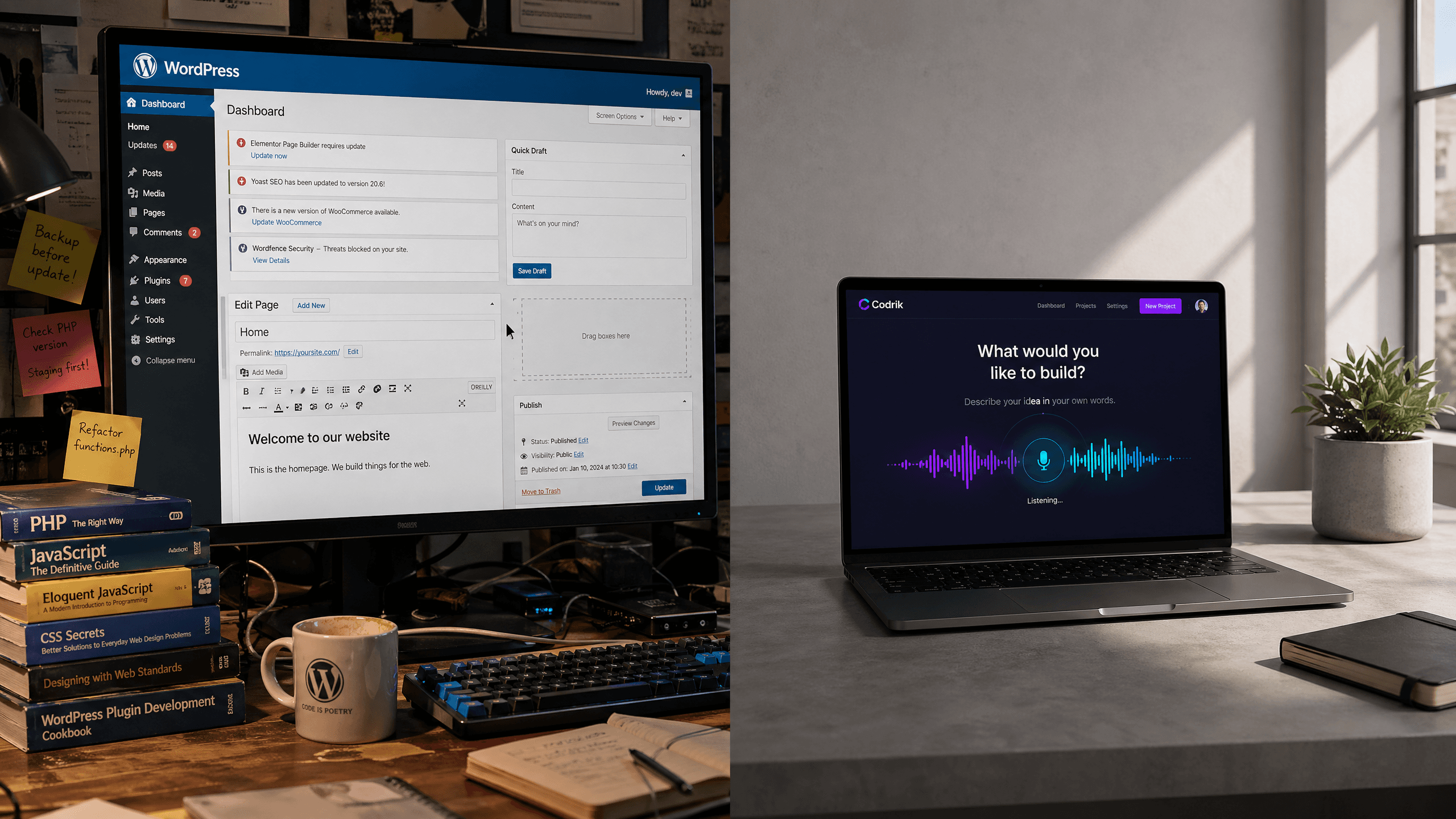
Every week a client emails us with the same question. They are sitting on a five year old WordPress site, the plugin updates are starting to throw errors, and someone in their network just launched a slick AI generated site in an afternoon. They want to know if they should jump. The honest answer is that for some of them WordPress is still the right tool, and for most of them it is not. The trick is knowing which group you belong to before you spend three months migrating something you did not need to migrate.
TL;DR: a one paragraph verdict
If you are a small business, freelancer, agency, or founder who needs a marketing site, landing page, portfolio, or company website that loads fast and looks current, an AI builder like Codrik will save you years of maintenance and probably a few thousand euros in plugin licenses and developer hours. If you are running a content publication with 5,000 articles, a WooCommerce store with custom checkout flows, a membership site with deep gating logic, or anything that depends on a specific WordPress plugin or developer integration, stay on WordPress. The split is roughly 80% of sites in the first bucket, 20% in the second. The mistake is assuming you are in the 20% when you are not.
Where WordPress genuinely wins
WordPress did not get to 43% market share by accident. The plugin ecosystem is unmatched. There are over 60,000 plugins covering everything from invoicing to LMS platforms to custom post type generators. If your business depends on a specific tool like LearnDash for courses, MemberPress for gated content, or WooCommerce with a custom payment integration, WordPress is the right choice and it is not close. The CMS itself is also genuinely good for content heavy sites. If you publish three articles a week with multiple authors, scheduled posts, taxonomy, and editorial workflow, the WordPress backend has had twenty years to get this right. And on a self-hosted setup you own your database, your files, and your migration path. That ownership is real. No AI builder can match that level of control.
Where AI builders genuinely win
Maintenance is the quiet killer of WordPress sites. A self-hosted WordPress installation needs core updates, plugin updates, theme updates, security patches, backup management, and PHP version upgrades. Skip any of those for six months and you have a security incident waiting to happen. Managed hosting helps but costs $25 to $35 per month and still does not solve plugin conflicts or compatibility issues after major updates. AI builders sidestep this entire category of work. Codrik builds a static site that does not have a database to compromise, a plugin to break, or a PHP version to upgrade. The site you launch in April still works in October without anyone touching it. For a small business owner who is not a developer, that difference is worth real money.
The total cost of ownership math
WordPress looks free until you start adding it up. WordPress.com plans run $0 to $45 per month, but the free tier puts ads on your site and the cheap tiers do not let you install plugins. Self-hosted WordPress.org needs hosting at $5 to $30 per month for managed providers like Kinsta or WP Engine, plus $50 to $300 per year for premium plugins like Elementor Pro, Yoast Premium, or WP Rocket, plus a developer at 800 to 1500 Kč per hour when something breaks. Over three years a typical small business WordPress site costs 60,000 to 120,000 Kč all in. Codrik is 490 Kč per hour for the build, average 35 minutes, plus an optional 249 Kč per month for hosting on Hetzner. Three year cost runs around 10,000 Kč. The gap is not subtle. The catch is that Codrik does not give you a CMS dashboard with editorial workflow and 60,000 plugins, so this comparison only matters if you do not need those things.
Performance, speed, and how Google sees you
WordPress can be fast. It is rarely fast by default. A typical small business WordPress site loads in 3 to 6 seconds because it ships jQuery, a render-blocking theme stylesheet, three analytics scripts, a slider plugin, a contact form plugin, and an SEO plugin that all want to run before the page paints. Getting to a Lighthouse score above 80 takes either a developer who knows what they are doing or a caching plugin that works most of the time. AI builders generate static HTML and CSS with minimal JavaScript. Codrik sites typically load in under a second on a clean Hetzner edge. For Core Web Vitals, which Google now treats as a ranking factor, this gap matters. The flip side is that WordPress with proper optimization absolutely can hit the same numbers, it just takes work that most small business owners are not going to do.
The content workflow question
This is where AI builders show their limits. If you publish daily articles with multiple writers, you need a real CMS. WordPress has scheduled posts, draft review, revision history, role based permissions, and editorial calendars built in or available as plugins. Most AI builders, Codrik included, are not optimized for this workflow. Codrik shines for marketing sites with 5 to 30 pages of content that updates a few times a year. For a publication or a content marketing operation putting out two articles a week, WordPress is still the better tool. There are exceptions. If you write occasional updates and post them to LinkedIn or a newsletter anyway, you probably do not need a CMS at all and a Codrik site with a simple updates section is enough. Be honest about your actual content output, not your aspirational one.
Ownership, lock-in, and the migration question
Self-hosted WordPress gives you genuine ownership. Your database, your files, your hosting account, your domain. You can move from one host to another in a weekend. AI builders sit somewhere else on the spectrum. Codrik generates real HTML and CSS that you can export and host anywhere, which puts it ahead of closed builders like Wix or Squarespace where leaving means rebuilding. But it is not the same as a WordPress installation where you have full database access and can dump and restore at will. For most small businesses this distinction is theoretical. They will not migrate. But if you are the kind of operator who wants the option to move everything to a different stack in five years without rebuilding, factor that in.
How to actually decide
Three quick questions. First, do you need a specific WordPress plugin or a custom developer integration that only exists in the WordPress ecosystem? If yes, stay on WordPress. Second, do you publish content multiple times per week with multiple authors and need editorial workflow? If yes, stay on WordPress or move to a headless CMS, but not to a basic AI builder. Third, do you have a developer or agency on retainer who handles the maintenance? If yes, WordPress is fine and the cost gap shrinks. If you answered no to all three, you are in the 80% who would be better served by an AI builder. The maintenance burden alone will pay back the switch in eighteen months. Codrik takes 35 minutes to build, costs 490 Kč per hour, and runs on EU infrastructure with optional 249 Kč monthly hosting. Try it before you spend another year patching plugins.