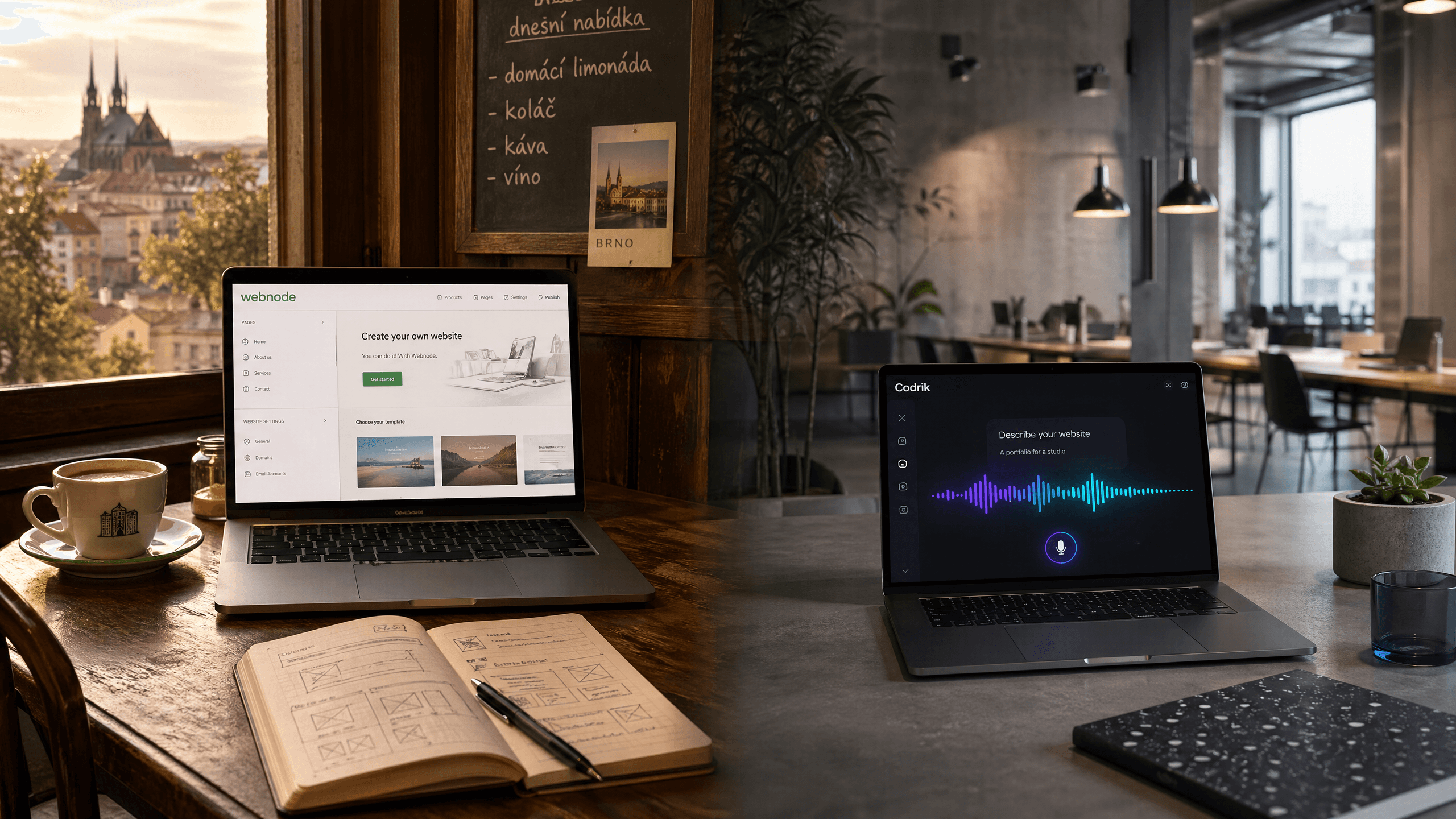
There is something quietly remarkable about the fact that two of the more interesting answers to the question of how non-technical people should build websites have come out of the Czech Republic. Webnode launched in Brno in 2008, when Vít Vrba and his team were betting that drag-and-drop editors would democratize the web. Codrik launched in Praha in 2026, betting that voice and AI would do the same thing again, only faster. This is not a takedown. It is a story about how the same country can produce two different answers to the same problem, fifteen years apart.
Two Czech companies, fifteen years apart
Webnode is a Brno-born builder that has been around since 2008 and now claims more than thirty million sites globally. It became one of the larger European website builders by being affordable, multilingual, and patient with first-time users. Codrik, founded in Praha in 2026 and operated by Revify s.r.o. on Na Čečeličce 425/4, is the much younger sibling. It has no claim to scale yet. What it has is a different starting assumption about how a modern website should be made.
Drag-and-drop versus describe-and-done
Webnode's experience is built on templates and a visual editor. You choose a layout, drag in blocks, write copy, and adjust styles. It is the model that defined DIY websites for a generation, and for many users it still works fine. Codrik replaces that loop with a conversation. You describe what you want, in voice or in chat, and the system generates a working site for you. The average Codrik build finishes in about thirty-five minutes. The skill ceiling is lower because the skill itself is just being able to explain your business.
Subscriptions versus hourly rental
Webnode runs on a subscription model. The Mini plan starts around 99 Kč per month, and the Standard, Profi, and Business tiers climb to roughly 599 Kč per month depending on what you need. That is fair pricing for a mature product, but it is also a recurring commitment whether you are actively building or not. Codrik charges 490 Kč per hour of building, which usually means one to two hours of total spend per site. Hosting, if you want it, is an optional 249 Kč per month. There is no monthly lock-in for the build itself.
Where Webnode genuinely wins
Honest comparisons require honest acknowledgments. Webnode has fifteen years of trust and a Czech-language support team that actually answers in Czech. It has built-in e-commerce, mobile editing, and multi-language support that have been refined over many product cycles. If you want a familiar, low-stakes way to put up a small store with reliable invoicing flows, Webnode is a credible choice. The price floor of 99 Kč per month is hard to argue with for a hobby site or a small landing page.
Where Codrik changes the math
Codrik's advantage is not that it is cheaper in every scenario. It is that the unit of work is different. Instead of paying monthly to keep an editor available, you pay for the building itself, then own a finished site. Voice input means a freelancer or a kavárna owner can describe their brand while doing something else, and walk away with a real page. The output uses modern AI aesthetics rather than templates that were drawn in a different decade. For founders, that visual difference matters.
EU self-hosting and where your data lives
Codrik runs on Hetzner Cloud in Falkenstein, Germany. That is European infrastructure under European data law, with no detour through American clouds. For Czech businesses dealing with GDPR-sensitive customer lists, that is not a marketing line, it is a procurement requirement. Webnode's hosting is also generally EU-based, but the broader point is that a 2026 builder can be designed from day one around regional sovereignty, while a 2008 builder grew up in a different cloud era.
Generative versus template-based
Templates are pre-decided. Someone, somewhere, drew a layout for a restaurant or a barbershop, and you fill it in. Generative AI inverts that order. Codrik composes the layout for your specific description, so two restaurants in two different neighborhoods do not end up with the same homepage. That is a meaningful aesthetic shift. It also means the gap between an amateur and a professional output narrows, because the system is doing the visual heavy lifting based on what you actually said.
Two generations, one ecosystem
The honest framing is that Webnode and Codrik are not enemies, they are bookends. Brno 2008 and Praha 2026 are the same Czech instinct showing up in two different technological moments. Webnode democratized DIY web building when that meant drag-and-drop. Codrik is doing it again now that AI can do most of the work for you. If you already have a Webnode site that works, there is no reason to panic. If you are starting from zero in 2026, it is worth asking whether a thirty-five minute voice conversation might get you closer to what you actually want.