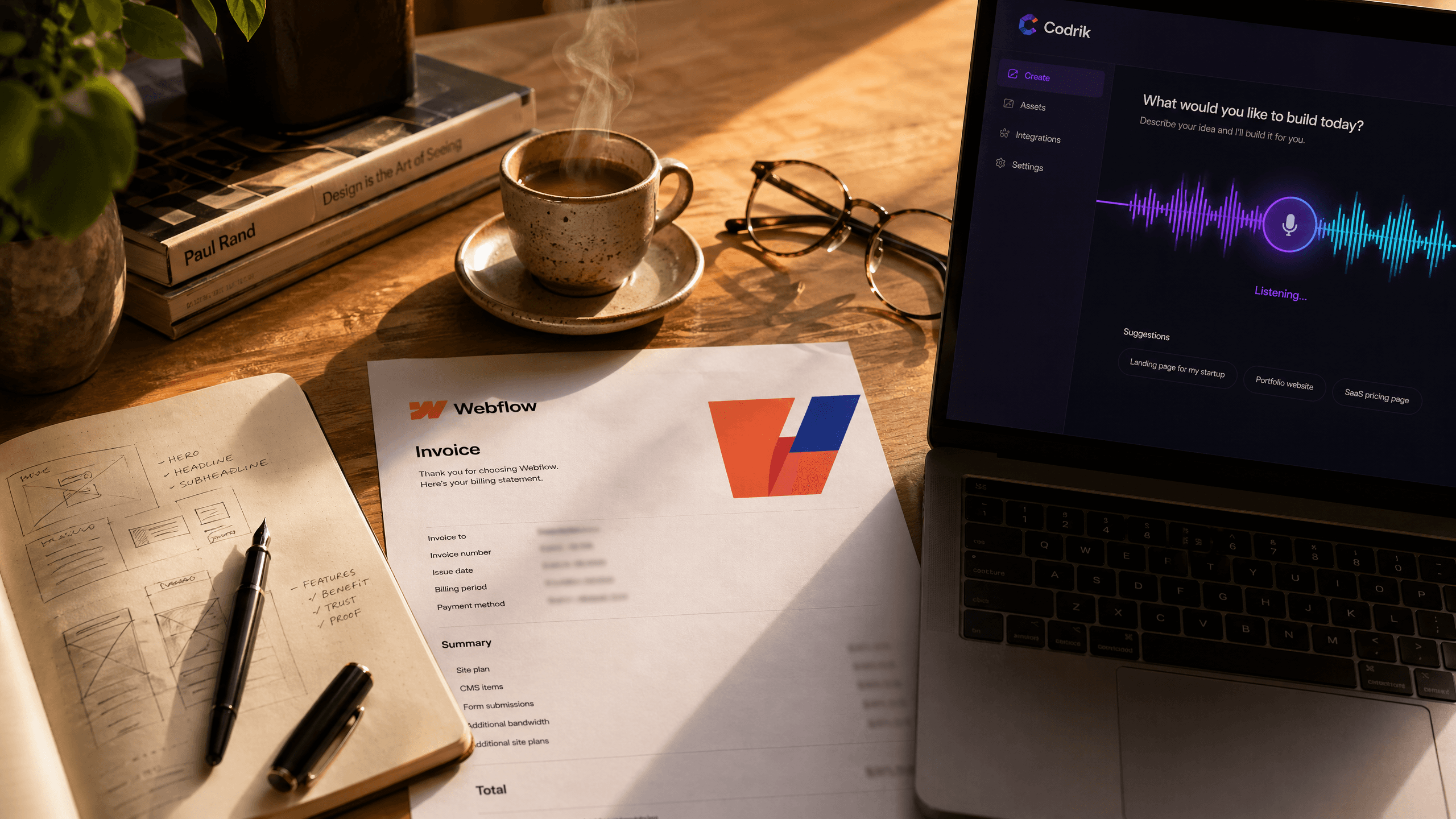
I have a soft spot for Webflow. I built my first proper portfolio in it in 2017, won a few awards with sites stitched together in its Designer, and spent more late nights inside its interactions panel than I care to admit. For ten years it was the answer to a real designer problem: how do I ship something that looks like I designed it, behaves like I designed it, and reads cleanly in source view, without writing a line of code. Webflow earned that throne. The question I want to sit with here is narrower and harder. In 2026, after a wave of AI builders that produce designer-grade output, what is Webflow still the right tool for, and what is it suddenly overkill for.
The real Webflow bill nobody quotes upfront
Webflow's pricing page starts at $14 a month for Basic and that is the number people remember. The number you actually pay for a real client site is not that. A serious project wants the CMS plan at $29, a Business plan at $39 the moment you cross the CMS item ceiling or need form submissions at scale, and another tier again the second you add e-commerce. Add a designer seat for collaboration, a content editor seat, a staging workspace, and you are quietly looking at $80 to $150 a month per site once the dust settles. Multiply that across the dozen or so SMB sites a small studio carries at any time, and Webflow stops being a tool. It becomes a line item your client questions every renewal cycle.
Where Webflow still wins, and I am not going to pretend otherwise
I am not here to write a eulogy. Webflow is still the best commercial tool I know for three kinds of work. The first is motion-rich brand sites, the kind of agency case study where scroll choreography and timed reveals are the design. The second is content-heavy CMS work where editors need a clean back office and developers need a clean export. The third is any project where the design system itself is the deliverable, where you are building components that another designer will compose with for years. For those, the Designer is still unmatched and the price is justified. If your next project lives in any of those three boxes, close this tab and open Webflow. We are friends.
The boring work that eats designer hours
But if I am honest about my own client list, those three boxes describe maybe a quarter of what actually pays. The rest is the boring middle. A clinic that needs a five-page site. A subscription box that wants a clean landing and a small product grid. A B2B services firm that finally accepts they need a real homepage. These projects do not need motion choreography. They need clear hierarchy, a confident type system, a contact form that works, and a launch date next week. And yet I used to spend three full days inside Webflow building each one, dragging div blocks, naming classes, redoing the responsive cascade for the fifth time. That work was not design. It was assembly.
What changes when an AI builder handles the assembly
This is the part that took me a year to admit. A voice-first builder like Codrik does not replace the designer. It replaces the assembly hour. I can describe a clinic site out loud, the kind of clarity I used to draft on paper before opening a tool, and have a working layout to react to in thirty-five minutes. The first pass is rarely the final pass, the same way a junior designer's first comp is rarely the final comp. But I am now art-directing instead of assembling. I am picking type pairings, refining copy, adjusting spacing rhythm, judging whether the hero earns its weight. That is the part I trained for. The grunt of pushing rectangles into a 12-column grid is not.
The price comparison nobody runs honestly
Codrik rents at 490 Kč per build hour, roughly twenty euros, and a typical small site takes one to two of those hours end to end. Hosting, if you want it managed, is 249 Kč a month, about ten euros. Compare that to a Webflow CMS site at $29 a month, $348 a year, $1,740 over the standard five-year client lifecycle, and that is before the Business upgrade, the e-commerce add-on, the second seat, the inevitable migration when the client outgrows the CMS limits. For a clinic site that will never need more than twenty pages and a contact form, the Webflow math is genuinely indefensible in 2026. Not because Webflow got worse, but because the floor of what a good AI build looks like has come up to meet it.
The new shape of the designer's day
What I tell other designers who ask me about this is simple. Your value was never in knowing where the padding token lives or in remembering the keyboard shortcut for duplicating a symbol. Your value is taste, judgment, and the ability to look at a client's messy brief and see the site they actually need. AI builders give you those hours back. Use them on the parts of the job a model genuinely cannot do. Sit with the founder for an extra hour. Rewrite the copy yourself instead of approving the draft. Pick a typeface that says something. Push back on the stock photo. The studios I see thriving in 2026 are not the ones who refused to touch AI. They are the ones who used it to delete the assembly hours and reinvest them in art direction.
When to stay on Webflow, when to switch
Here is the rule I now use on intake calls. If the project is a brand site for a client who cares about motion, a content platform with a real editorial team, or a system that will be inherited by another designer, I quote Webflow and I quote it without apology. If the project is a fast-launch SMB site, a service business homepage, a clean landing for a product, or a redesign where the brief is essentially make this look like you would have designed it, I quote Codrik. The first kind of work justifies $100 a month. The second kind never did, we just had no honest alternative. We have one now, and pretending otherwise is going to cost designers margin they cannot afford to leave on the table.
The end of the era, not the end of the tool
Webflow is not dying. It is becoming what Adobe became to print designers around 2010. A premium professional tool, beloved by a smaller and more specialised audience, charging accordingly, and still the right answer for the high end of the craft. What is ending is the assumption that Webflow is the default answer for any designer who does not want to write code. That default belonged to a decade when the only alternative to Webflow was a worse Webflow. The alternative now is a different question entirely, asked by voice, answered in minutes, and priced like a tool instead of a subscription. The designers I respect are already running both, picking the right one per brief. That is the only Webflow alternative 2026 conversation worth having.