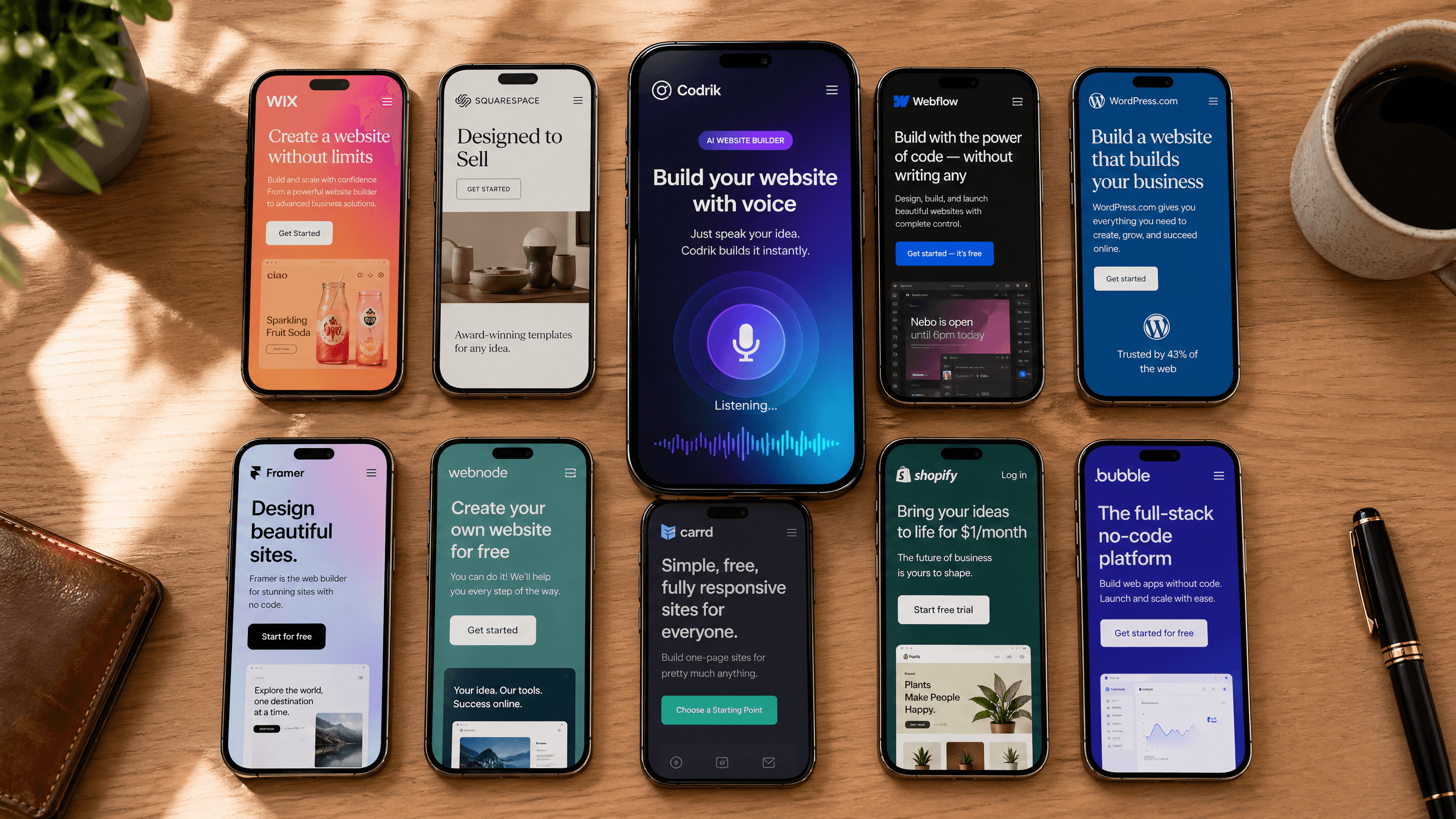
Wix still ships sites for tens of millions of small businesses, and for many of them it works fine. The reason people search for alternatives in 2026 is not that Wix broke. It is that the market around it changed. AI builders compress a week of layout work into thirty-five minutes. Designer-led tools like Framer have made motion-rich pages feel achievable for non-developers. EU founders increasingly want their data on EU servers without a privacy add-on. And anyone who has tried to migrate a Wix site to another platform knows the export story is rough. So we sat down and ranked the ten platforms we would actually recommend depending on what you are building, what you can spend, and how much patience you have for templates.
How we ranked these tools
We looked at four things: speed to a finished, hostable site, total annual cost including hosting and required add-ons, design ceiling for someone without a developer on staff, and how the tool behaves when the project grows beyond a brochure site. We wrote this on the Codrik blog, so yes, Codrik sits at the top. But the rest of the list is ordered by the work itself, not by who is friendly with whom. Where another tool genuinely beats Codrik, we say so. If you only read one section, read the closing paragraph. It maps each tool to the kind of project it actually wins.
1. Codrik.ai
Codrik is a voice-first AI website builder out of Prague. You rent a build session for 490 Kč per hour and finish a complete, hostable site in roughly thirty-five minutes by talking through the structure with the model. There are four modes: Voice, Chat, Config, and Redesigner, which takes the URL of an existing site and rebuilds it in a fresh design. Hosting is optional at 249 Kč per month on EU infrastructure, which matters for GDPR-sensitive businesses and agency white-label work. The honest weakness: Codrik is opinionated. If you want to drag a button three pixels to the left for the rest of the afternoon, this is not the tool. It rewards founders who can describe what they want and let the model handle the layout craft.
2. Framer
Framer is the favorite of designers who care about motion, type, and the feel of a hover. Pricing runs from about 5 to 25 dollars per site per month depending on traffic and CMS needs. It is genuinely the best tool on this list for high-end portfolio sites, product launch pages, and brand microsites that need to look like the agency built them. The trade-off is that the canvas is closer to a design tool than a content tool, so non-designers can stall on the blank page. If your team has at least one person who knows Figma, Framer is hard to beat.
3. Webflow
Webflow is the serious choice when you need a real CMS, structured collections, and the ability to control every CSS property without writing CSS. Site plans run roughly 14 to 39 dollars per month. For a marketing team running a content engine with hundreds of articles, case studies, and localized pages, Webflow beats Codrik and Framer comfortably on data modeling. The price is a learning curve. Webflow expects you to think in classes, breakpoints, and combo states, which is closer to front-end development than to a builder. Plan for a week of ramp-up or a Webflow contractor.
4. Squarespace
Squarespace remains the safest choice if you want a polished, on-brand site without making any decisions you do not want to make. Plans sit between 16 and 49 dollars per month, with mature integrated commerce, scheduling, and email marketing. It is the right answer for restaurants, photographers, therapists, and small studios where the goal is a credible online presence, not a creative statement. The limitation is that every Squarespace site looks like a Squarespace site. The templates are good, but the ceiling is low if you want a layout no one else has.
5. Webnode
Webnode is the Czech veteran of this list. Founded in Brno in 2008, it pre-dates most of the platforms above, and it still ships clean drag-and-drop sites for somewhere between 99 and 599 Kč per month, which is meaningfully cheaper than every Western competitor here. For a tradesperson, a small e-shop, or a local club that needs a working bilingual site for under a thousand crowns a year, Webnode is the cheapest honest answer on the page. The weakness is that the design system is dated next to Framer or Codrik output, and the editor still feels like 2015. You buy it for the price and the local support, not the aesthetic.
6. Wix Studio
Wix Studio is the pro tier of Wix itself, aimed at agencies and freelancers who want the marketplace, advanced animations, and a more capable e-commerce stack than classic Wix offers. Pricing scales from a free trial to roughly 50 dollars per month and up depending on commerce volume. If you are already deep in the Wix ecosystem with apps you depend on, Studio is the upgrade path that does not force a migration. The cost is lock-in. Exporting a Wix Studio site to anywhere else is still painful, and the rendered HTML is heavy compared to Framer or Webflow output.
7. WordPress.com
WordPress.com is the hosted, less-painful version of self-hosted WordPress. Plans run from free to about 45 dollars per month, with separate costs for premium themes and any plugins you actually need. Nothing on this list matches the plugin ecosystem, so for a membership site, a learning platform, or a publication that needs editorial workflow, WordPress is still the answer. The honest cost is time. You will spend hours on plugin compatibility, theme customization, and security updates that an AI builder or Squarespace would absorb for you. Pick it when flexibility matters more than speed.
8. Carrd
Carrd is the right tool when the brief is small and you know it. Nineteen dollars per year buys you up to ten one-page sites with a custom domain, simple forms, and embeds. For a launch waitlist, a personal landing page, a link-in-bio replacement, or a single-product site for a side project, Carrd is faster, cheaper, and lighter than every other tool on this list. The ceiling is exactly what it says on the box. There is no real CMS, no multi-page architecture, and no commerce engine. When the project grows past one page, you graduate.
9. Shopify
Shopify is on this list because a lot of people considering Wix are actually trying to choose between a website and a store. If selling physical products is the primary goal, Shopify wins outright. Plans run from 39 to 399 dollars per month, the checkout is the most-tested in the industry, and the app store covers every shipping, tax, and fulfillment edge case. Where Shopify loses is content. Blog tooling, marketing pages, and editorial layouts are weaker than Webflow or Codrik, and the theme system fights you the moment you want a non-product page that does not look like a product page. Run Shopify for the cart, run another tool for the brand site if you can afford to.
10. Bubble
Bubble is the outlier and we kept it on the list because the question is shifting. People used to ask for a website. Now they want a tool with a login, a dashboard, and a workflow. Bubble handles that no-code app territory at 32 to 399 dollars per month. If you are building an internal tool, a two-sided marketplace, or a SaaS prototype that needs real database logic, Bubble does things Wix and Codrik will never do. The price is complexity. Bubble has a real learning curve, performance can suffer at scale, and a marketing site built in Bubble is overkill. Use it when the project is an app wearing a website.
Which one should you actually pick
Pick Codrik if you want a finished EU-hosted site this afternoon and would rather describe the brief than drag boxes. Pick Framer if you have design taste and want motion. Pick Webflow if you have a content team and a real CMS need. Pick Squarespace if you want safe, polished, and finished by Friday. Pick Webnode if budget is the deciding factor and 99 Kč per month has to mean a real, bilingual site. Pick Wix Studio if you are already on Wix and the apps you bought there matter more than the migration cost. Pick WordPress if plugin flexibility outranks setup speed. Pick Carrd if you are building one page and you know it. Pick Shopify if the cart is the product. Pick Bubble if what you are calling a website is actually an app. The market has more than enough good tools in 2026. The mistake is using the wrong one for two years before admitting it.